/Init
There are multiple kinds of wrong. Wrong vastly outweighs right, since right is often described as a singular limited state or definition, and everything else is being labeled as wrong. It is not just 1% vs 99%, it is more like 0.00000001% vs 99.99999999%.
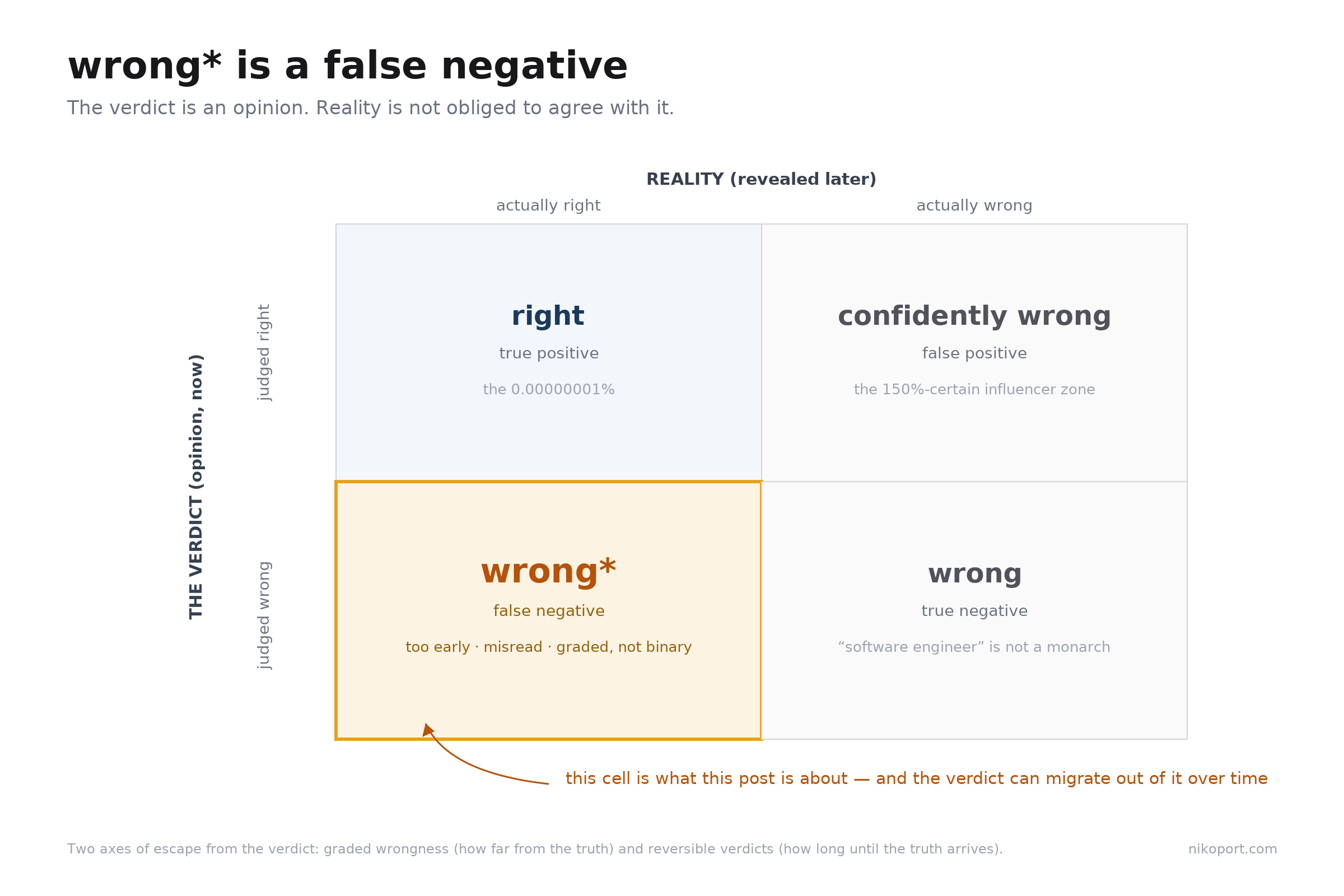
Wrong* – for the scope of this blog post, is used as a term describing a false negative, which can arise along either of two axes — graded wrongness or reversible verdicts.
Being wrong is not equal to being wrong*. The certainty of the outcome rarely stands for eternity.
TLDR
The main angle of this post or TLDR is simply that the judgment of being wrong is a personal or a collective opinion, while avoiding answering some rather difficult questions, such as:
– is the wrong* opinion truly understood before being simply discarded through common bias?
– who is the person providing the “particular” opinion? Are they competent professionals in the respective area?
– is the definition of wrong* being assigned by the person evaluating the case or is it just being “inherited” from some “specialists”?
– is there a case or subset of cases where the wrong* opinion is right?
– is the wrong* opinion just temporarily incorrect (too late, too early)?
In my professional experience, I have worked with a number of people who considered that everything can be split into right and wrong, just as 1+1 always equals 2. Well, in a rather simple mathematical sense, it is totally correct, 1+1=2, but tell me that Brooks’s Law from The Mythical Man-Month means nothing in real life and adding a new programmer to an already existing one will double their throughput on a project and as per my experience – you have no clue how most projects work.
I am not arguing about the things that are easy to express in a mathematical formula, but as in real life we call the less relevant skills ‘Hard Skills’ — because they are easily measurable — while the ‘Soft Skills’, the key competences and capabilities, are often unbelievably difficult to measure.
Guilty as charged
I usually introduce myself as being wrong most of the time. This is not because I believe that I am exceptionally right, but mainly because on the day I know that I am right more than 50% of the time statistically, I will drive to the nearest casino and ‘clean up the bank’.
I am guilty of making a lot of fast decisions and declaring things to be wrong, while they were largely wrong*. As Daniel Kahneman explained in Thinking, Fast and Slow with his two systems of thinking, it feels like the fast, careless decisions have produced the largest share of my wrong visions and decisions. I have predicted that some database technologies such as Hekaton would have a bigger impact than they actually did. On the flip side, I have discarded things and technologies that time has proven to be right. I am not pretending to be the almighty truth-seer, because I have no illusions of being one.
Binary wrong
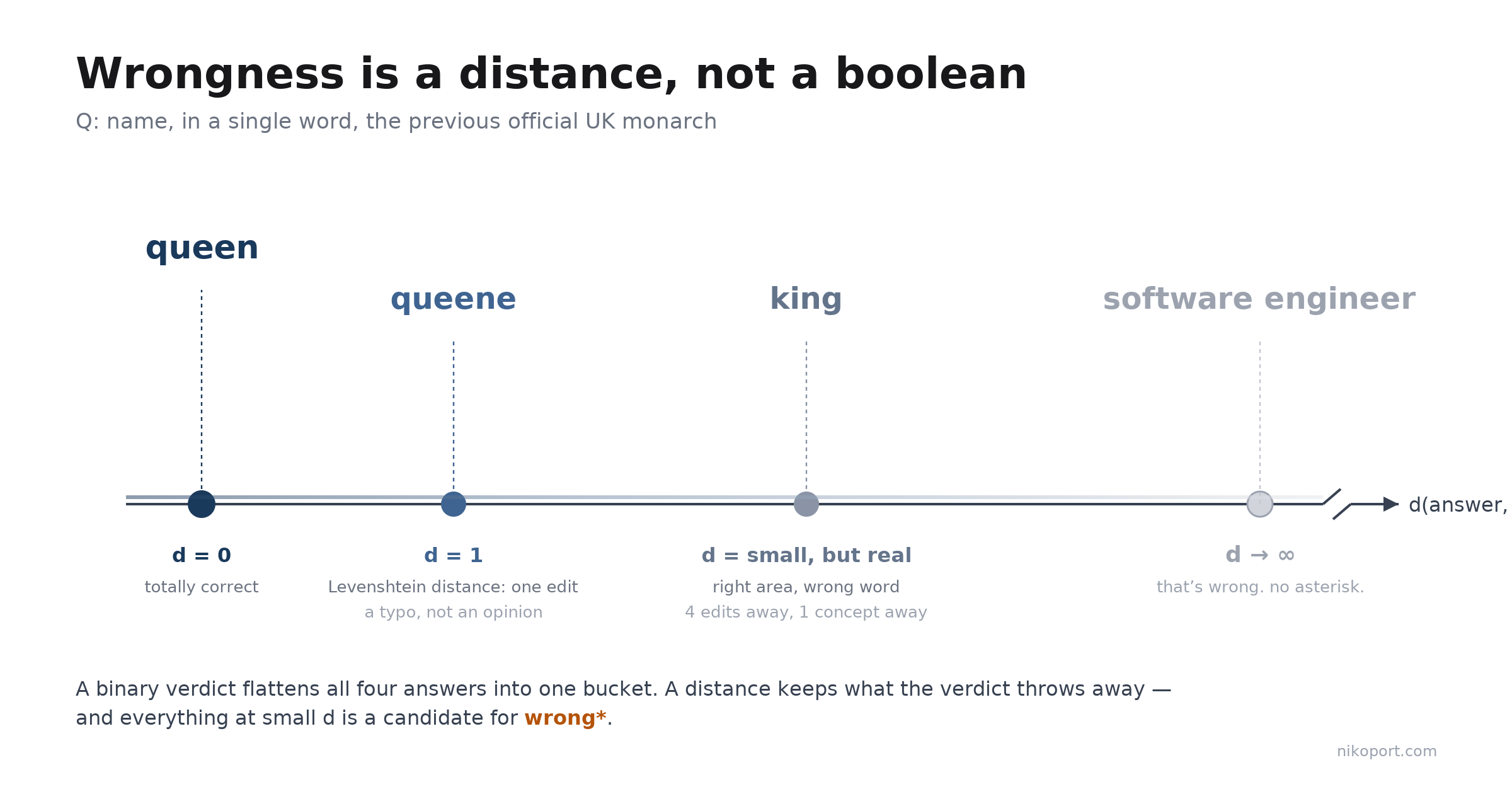 The way humanity classifies right and wrong is just like black and white. And the funny thing is that it is almost never black and white.
For so many years my favorite example has been when someone is asked to write down, in a single word, the previous official UK monarch, and the results are:
– queen (totally correct)
– king (the area is right but the word is wrong)
– queene (well, that’s not totally wrong, maybe just a typing mistake)
– software engineer (that’s wrong)
The wrong timing
A lot of times, the wrong* idea/opinion/prediction is not wrong at all – it is simply not timed well.
When a prediction is not timed well, a description of wrong* might be applied to an idea/opinion/prediction – while factually it is not totally wrong.
Remember one of the best rules for politicians for any future prediction – “give them a number or give them a date, but never both“.
In order to be EXTREMELY right with something, you gotta be ready to be wrong a heck of a lot of times. This position resonates hugely in the financial community and referring to the amazing Nassim Taleb and his Black Swan — it is something I strongly believe in. When looking for the bigger truths, one needs to pass through a lot of wrong takes and opinions.
The wrong* understanding
Sometimes being wrong and insisting on the interpretation will lead to a deeper understanding of how a product or a feature can be used. Sometimes it will result in product/feature being adapted or adjusted to serve that purpose. Naturally, sometimes, that understanding simply gains a separate life and usage – that the product team themselves are unable to realize or understand. Just to back it up, MDS was one of those features that were particularly “misused” for many different purposes, including governing itself. :)
We live in times of fake information (*sigh*) and fake certainty – those “Influencers” who will tell you with 150% confidence information that takes just 15 minutes to verify as untrue.
From the other angle – current society neither rewards nor recognizes reasonable doubt, and at the extreme, one will hear things such as “you need to be confident as a man”.
It is a dangerous and slippery slope, since insisting on something just because you would love it to be right, leads to very bad consequences.
LLM kinda wrong*
What concerns me significantly these days is not the agent/LLM technology itself, but how humans are going to misuse it, and how the certainty of LLM responses is going to affect younger generations unused to doubt. LLMs still largely do not have an ‘I cannot find the answer’ mode enabled by default, and they deliver their answers with certainty and authority. I would love to see the LLMs responding – “I have found an answer, but it is possibly wrong, since there is strongly contradictory evidence”.
I am concerned that the certainty of LLMs will remove the possibility of alternative paths and alternative ideas, and that will push towards a monotonous single-minded vision of the world.
Wrong* efficiency
Not every single most efficient path is straight, and an indirect route might be as perfect as it gets in the real world.
On a map, the straight line is rarely the route you take. Even the fastest path by distance misses what matters — traffic, events, terrain. The route that’s shortest on paper isn’t always the one that gets you there.
Efficiency, chased too literally, stops being efficient.
Looking wrong or inefficient does not make it wrong.
“You are not wrong”
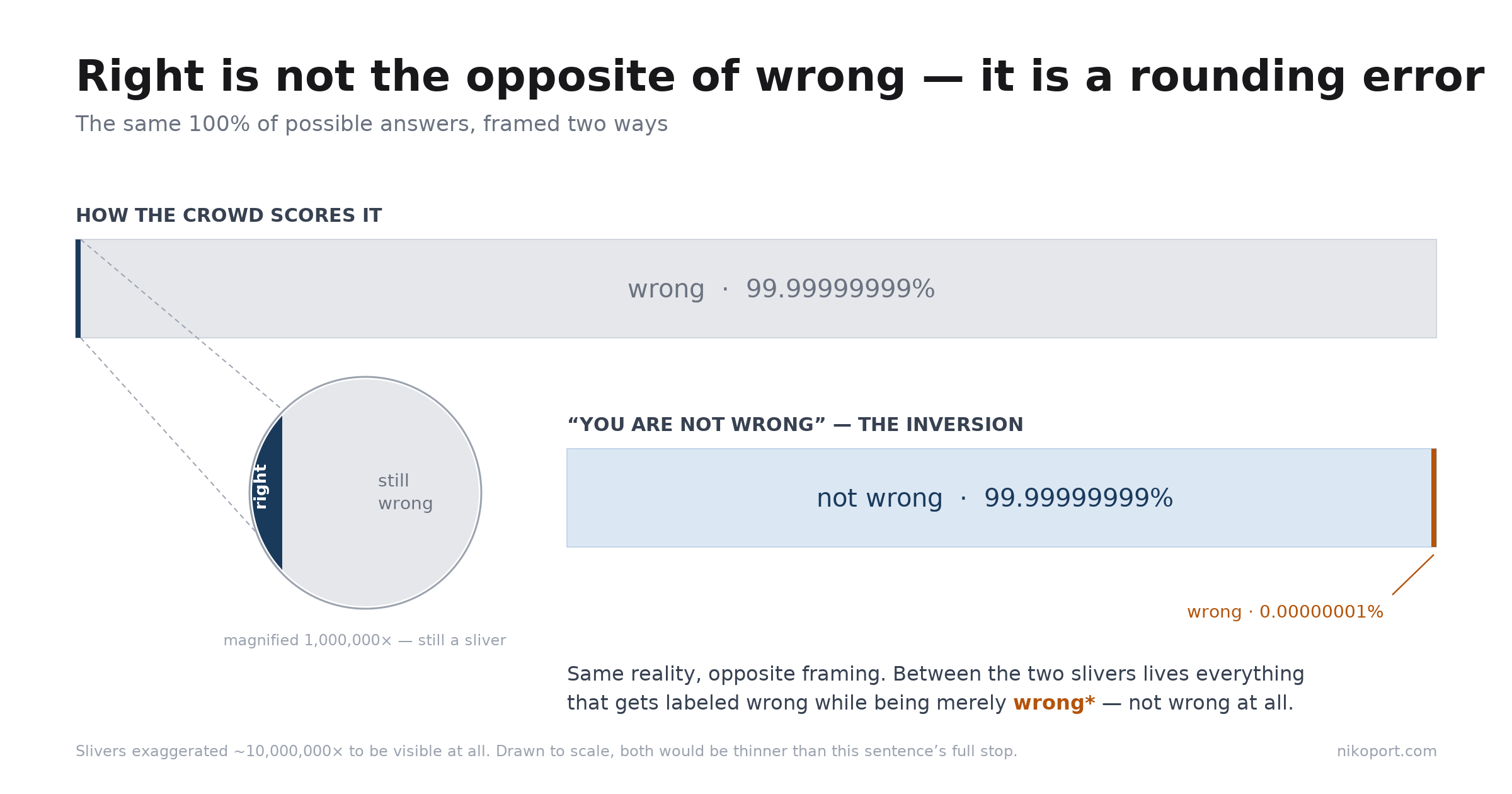 A good friend of mine with whom I talk frequently uses the assertive, confirming phrase “You are not wrong”. This has always struck me as an amazing angle on how most people treat right and wrong – but in reverse. Framing the concept of ‘wrong’ as a single tiny slice and declaring that not being wrong represents the majority of outcomes is not only refreshing but a more realistic approach to reality.
Wrong tellers and Truth seekers
It is not THAT difficult to determine things that are badly wrong, but it is rather difficult to find the things that MIGHT be not-completely-wrong or even wrong*.
The good thing is that I know enough good rebels who will call a spade a spade, and by virtue of being truth-seekers, they are open to others being not-so-wrong. Those truth-seekers will disregard crowd-pleasing agreement and say things plainly. Those people are, of course, no politicians, nor are they loved universally – but they move the needle forward by providing honest feedback and looking for the right more than looking to “be right”.
For me, that group is a band of rebels, especially in the AI-dominated age, who are going to challenge the status quo of the accepting majority – thus helping humanity and society to evolve.
Telling Wrong from Wrong*
The key question here is how one can distinguish a real wrong from the false negative (aka wrong*). And make no mistake: when I wrote that I am wrong most of the time, that is truly how I see myself.
I won’t provide you with a ‘Lifehack’, ‘Snake Oil’, or ‘Utopian vision’ — because I do not have one.
I suggest searching for evidence and analyzing the current state and describing a desired state where the outcome becomes not wrong. Then provide a possible and plausible path toward that state — one that takes a realistic, achievable amount of time.
Sometimes the evidence will help you, and sometimes there is none. Remember, some of the most ground-breaking discoveries were at some point universally judged to be impossible. When to stop believing in a positive outcome — I will leave that up to you.
Consider clarity and honesty: by being open about the state of things — whether it benefits you or not — you will get further as a human and help society advance.
Tell it as if you have skin in the game, because on the important matters you probably do. And if you do not – then show a bit of character and be honest about your best intentions and declare that you are actually just exploring the opportunities.
If you are running a database workload, ask and vote for the features and databases that provide you with solutions and paths to solving real business problems. I am a believer that the one who searches eventually finds the way, even if it takes a longer path. For example, if, in a feature, you see a particular use case, even though it is described as wrong – but the technology still acts that way – good research on whether the behavior is wrong or really wrong* will be needed.
Well, here is a story I have told to just a handful of people before. Many years ago, a well-known researcher sent me a copy of a whitepaper he was about to publish. He wanted my opinion and feedback. He was too kind and I still feel today that I did not deserve that. I did my best at the time (which by today’s view was mediocre at best), but I had a point of view and I implied in my answer that some part of the technology should have worked in a different way. He replied, confidently and reasonably, that he had researched it and that it should work the way he had described. It looked like I was wrong and I did not argue. And surprisingly, around six months later, I was not just wrong* but eventually even “not wrong”.
For many years one of the maxims in my house has been – if the future generations are not ashamed of our behavior and of us being extremely wrong and naive, then society has not moved the needle far enough.
We are all extremely wrong in our beliefs and assertions, we just do not know or do not understand it.
Final thoughts
Well … I just might be wrong again with my way of seeing things.
But I’d rather be wrong and find out if, by some good chance, I just might be wrong*.
A very important person in my life, weeks before passing away, told me – “Never agree by default. Be the contrarian voice. Because it matters. Because the majority is always agreeing.”
Nice; critical thinking seems so passé these days. This is a great post that our agents would do well to read.