 I have worked with Master Data Services (aka MDS) extensively, especially during the engagement at OH22 around a decade ago, and I my interest in the area and that specific is documented in my blog – with the following examples: What is wrong with MDS (Master Data Services) Database in SQL Server 2019 & Master Data Services in SQL Server 2019.
In my professional experience (at OH22) I even had to dig into the internal code of the MDS and from my experience the Software Engineers at Microsoft at MDS team I have talked to – knew much less about it than I did.
MDS was launched in SQL Server 2008 R2 and the feature was there with minor changes since SQL Server 2016, with the last update being done in SQL Server 2019. Now, in SQL Server 2025 we have a significant change – Master Data Services are dead. Yes, you read it right – not deprecated and will be removed in the future, not deprecated and unsupported, but – removed.
This is quite disappointing and disruptive change, especially since there are no alternatives directly in the product. Without warning and with no further advice. Do not start even talking about Purview – the most confusing and overpromising product in the whole BI stack. A product that for the longest time had no clear pricing nor strategy – has no future, unless it proves itself.
As I said it before (and it got me into trouble around 2016) – Microsoft has no real vision for the Master Data Services, the idea of “Fabric will be everything for everyone” – is weak.
If you have never worked with MDS, and thought that you know about it because you read a blog post or two – you have no idea. MDS was by very far not the perfect product, it had painful limitations, the competitive products (Profisee or Informatica MDM for example) had ten times better capabilities, etc – all of this is true.
I guess the killing of the Big Data Clusters gave the idea that removing parts of the product has no consequences (and in the case of BDC, I believe the impact was truly limited and the usage was traceable), but I am disappointed in the decision.
This was a management point of view and as a Product Manager I can see how it was presented as a management improvement, but trust me when I say that there will be a price to pay. For the Business Intelligence stack, I would have to see at least a couple of versions of the product to be able to trust it and to recommend others to do that.
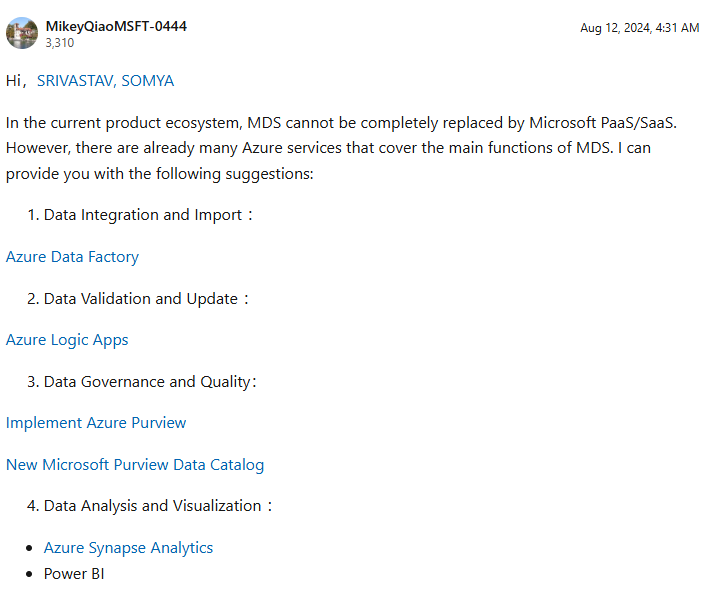
The main reason for my disappointment is the fact that the capability is left dead without any further steps. Nobody in Microsoft even had courage to post something about a product that was not truly understood by the company that bundled it into SQL Server. Here is the example of an answer – that points every possible direction, except of course the most right one – what is the alternative from Customers doing an effective writeback from Excel to SQL Server:
I imagine a lot of people in SQL Server community laughing off Master Data Services removal, but if you have ever worked in the BI & Analytics world, you might be seeing this act as something different and quite negative, like I do.
Imagine that your customer has 100s of BUSINESS users and that you are telling them that you won’t be migrating to any new SQL Server version, since the product simply removed the feature that made some key business processes running. There are alternatives – even not as expensive ones that I have mentioned above, but since I have never used them professionally, I can’t recommend them.
I know that customers will find a solution, but I truly wish that Microsoft Business Intelligence LT (Leadership Team) would put in charge some people that really understand the business intelligence needs and not just NVTPs (Not Very Technical People). Overall this would be much cheaper and more efficient then acquiring companies with good products just to drop/remove them from the product a couple of versions later.
Saying that some Azure services cover the main functions of MDS and then list Azure Logic Apps is laughable. It basically means: rewrite all of the MDS capabilities yourself.
Hi Nico – as usual you talk a lot of sense.
I attended your SQLBits course on Azure PDW + ColumnStore around 8 or 9 years ago and greatly enjoyed it.
When our organisation had to decide which new DW platform to go with 5ish years ago, we evaluated various cloud DWs and ultimately chose Snowflake. Synapse felt then like it had fallen well behind. I hear that Microsoft stopped development of it a couple of years ago. The latest in a long line of things Microsoft started and never developed consistently. The Microsoft response in your screenshot is laughable. I am very cautious now in adopting anything that is new in the Azure data ecosystem. Their past behaviour is surely hurting them now in getting adoption on new products/services…
Hi Niko,
You’re one of the few people writing about this who actually gets what MDS was used for in practice. Most commentary treats it like some minor feature nobody cared about. Tell that to the finance teams maintaining 200+ cost center codes through the MDS web UI every month.
I’ve been deploying and maintaining MDS since 2008 R2. Never loved it, but it worked. The Excel Add-in was painful, the web UI looked like 2010 forever, and the global ImportType settings drove me crazy. But everything lived in SQL Server, you could query it directly, and you didn’t need a cloud subscription or consultants.
What Microsoft did with the removal is exactly what you describe – no transition path, just “use Purview.” I’ve tried explaining to clients what Purview actually does versus what MDS does. It’s a pointless conversation because they solve completely different problems.
I ended up building my own replacement. Spent the last year on it. Same philosophy – data in SQL Server, on your server, query it with T-SQL – but with a modern interface and without the IE dependency. Called it Primentra (primentra.com). It includes a migration wizard that imports MDS models and data directly.
Not trying to compete with Profisee or Informatica here. Those are real enterprise platforms. But most MDS installations I’ve seen were managing reference data with maybe 10-50 users. Those teams don’t need a six-figure contract.
Appreciate the honest take. The BI community needs more of this and less “embrace the cloud journey” messaging.
Ronald